


There's a nervous excitement. I can see the cold breath coming from my fellow runners as they perform the "pre-race" shuffle on the start line.
A quick flick of the hips.
I'm lined up for my local Saturday morning race and I'm focused. Three, two, one...
Hold on. I need to sort my tracker. The same goes for the guy beside me.
The person in the line expresses impatience. I refuse to go until… there! Signal acquired, I'm off.
In the mele, it's challenging to find a arm without a smartwatch on it. And it's not just us runners who rely on them.
We're witnessing a explosive, multi-billion pound sector. Names like Garmin lead the market, all offering an extensive range of diverse models to cater to a variety of budgets. According to how high tech the device you go for, costs can vary between £100 to thousands of pounds.
"It makes me crazy, I'm unable to relax."
"It reassures me… It acts as a friend encouraging me."
"Stop telling me about a bad night's sleep."
A handful of the comments people have shared from fellow device users when I question what they feel about theirs.
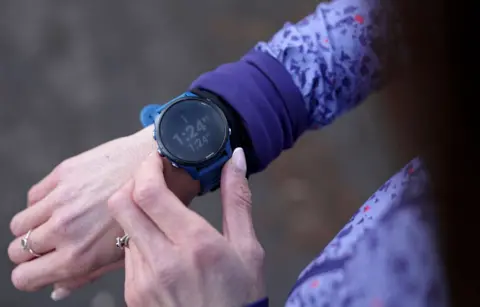
The Data Dilemma
My current opinion on my own device? At this moment, annoying. It's reporting I'm off pace, causing me to question whether the overhead branches along my route are interfering with my satellite signal.
Countless individuals of us strap these compact monitors onto our arms and keep them on all day and night, apparently unconcerned with the fact they're continuously monitoring us.
Gone are the days when we relied on them only to give us an estimation of our step count. Today, they can analyse our sleep patterns, heart rate, oxygen saturation, our body battery.
It's a challenge to find a bodily function they don't track.
But do they do what they claim to do? And are the numbers we obsess over a accurate representation of our actual health? Do they enhance our overall health, or do the plethora of readings and cheerleading alerts just contribute to our sense of overwhelm?

Addiction or Aid?
"I become a quite fixated with mine," an individual reveals.
While she values how her device records her runs, she finds some of its other functions "excessive" at times - a feeling first discovered during a significant period.
Until she found out she could change its configuration, her smartwatch kept telling her she was failing to be active enough. Later on, the watch frequently reports her she's had a bad night's sleep.
"I am caring for a six-month old, I don't need to be informed I'm tired," she says. "I know that all too clearly."
Why doesn't she just take it off?
"It's possible, theoretically, but I've got this push-pull dynamic with it," she says. "I value it for its exercise data, I just wonder whether all the other things it can now do is perhaps overkill for me."
Inside the Device
Each model of smartwatch has its own unique way of measuring your health metrics and analysing your data, but the vast bulk use optical sensors on the underside of the watch.
They commonly shine tiny, coloured LED lights onto your skin which can monitor blood flow, recording your BPM. More advanced devices detect changes in the electrical current that runs through the skin to gauge your nervous system activity.
Expert Perspectives
A professor says that for most people for smartwatches, it's a "fine balance" - while the continuously improving tech could potentially prevent illness, "detecting disease before we show symptoms", it could also turn us watch wearers into the "anxious healthy".
He points out that the most advanced wearables can carry out tests like heart rhythm analysis, which continuously monitor how normal the heart is. They can alert if someone is experiencing an irregular rhythm, where there is erratic signals in the heart causing an arrhythmia.
This does not automatically signal someone is about to have a cardiac event, but it can give an preliminary indication they might be more vulnerable of a heart problem in the long term.
But how to make sense of these figures is not straightforward. The expert fears that as more functions are added, people may find it hard to fully comprehend their data.
"I have some doubts that being able to monitor so many metrics is such a positive development," he says.
A health researcher specialising in patient behaviour echoes this sentiment. Research into the influence of wearable tech on a specific group of heart condition patients suggested a minority of those who were given devices to monitor their condition experienced heightened worry and were "had a higher tendency to use medical services".
She identified a vicious circle with her patients - they saw a worrying figure on their watch. They felt anxious. Their pulse increased. They got more worried. They checked again, and their reading rose further.
"If we see data about ourselves that we don't really understand then, of course, we are going to want to know more," the psychologist says. "We look, we obsess - it becomes a self-fulfilling prophecy."


